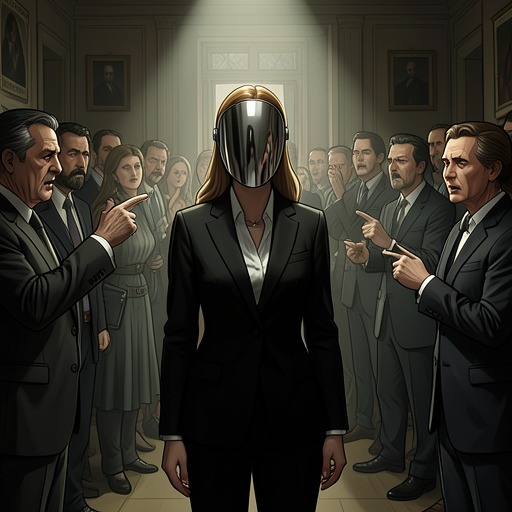
Gu Residence Villa
I’m Very Happy After Marrying the CEO Husband According to the AgreementGu Residence Villa is the home associated with Gu Huaian and Shen Tang, a domestic space that repeatedly gathers the consequences of their public lives. Its decisive significance lies in the contrast it creates: outside, their relationship is displayed before business partners, fans, and acquaintances; inside, the performance of marriage becomes entangled with genuine attachment, appetite, friendship, and the ordinary interruptions of a shared household.
Setting and Domestic Function
The villa functions as a private counterpart to the highly managed spaces that surround Shen Tang’s career. Her marriage agreement requires only occasional family dinners and the appearance of a loving couple, while promising a monthly payment of five million and a two-hundred-million settlement after two years. Against that contractual arrangement, the villa becomes the place where the supposed appearance of intimacy is repeatedly tested by unscripted behavior. It is not merely a residence supplied by the agreement but a setting in which the relationship acquires habits that the contract itself does not prescribe.
The house also accommodates the practical aftermath of Shen Tang’s work. After a formal banquet, she returns with Gu Huaian and intends to rest for one night before rushing back to the film set, where shooting is already in its final stages. The villa therefore offers temporary recovery rather than permanent escape: even at home, the demands of filming and public life remain close at hand.
Arrival and Thresholds
A significant return begins when Gu Huaian’s car reaches the villa and he notices two vehicles following behind. He approaches the first car and taps on its window, only to hear Cen Songbai’s puzzled voice. He then goes to Gu Yun'an’s car; before he can speak, Gu Yun'an announces that he is leaving. The sequence establishes the villa’s entrance as a threshold that controls access to Gu Huaian’s private life. Friends may accompany him to the property, but his reaction makes clear that arrival does not automatically mean admission.
Gu Huaian refuses to let the visitors enter and describes them as being in the way. Holding Shen Tang’s hand as they walk toward the house, he explains that it has been a long time since they had seen each other and that he does not want to stay with the others. Shen Tang privately calculates that the separation was not actually very long because they video-chat every night. The discrepancy gives the threshold a relational meaning: Gu Huaian experiences the return as an opportunity for exclusive closeness, while Shen Tang evaluates it with more practical, less romantic precision.
Household Intimacy
The villa’s emotional center is Tao Sister’s welcome. Hearing the car, Tao Sister runs out with her body trembling and greets Shen Tang as the madam who has finally returned. Shen Tang responds by calling to Tao Sister, letting go of Gu Huaian’s hand, rushing over, and embracing her. The gesture redirects the scene’s emotional energy. Gu Huaian arrives beside Shen Tang as her husband, but Tao Sister’s welcome reveals that the house is also sustained by an affectionate household bond independent of the public couple image.
Food further changes the atmosphere. Shen Tang has eaten little at the banquet because she fears that too much food will make her belly bulge and stretch her clothes; once home, she can eat freely. The movement from restraint at the formal event to appetite in the villa turns domestic space into a release from appearance management. Yet this release also leaves Gu Huaian momentarily outside the scene: Shen Tang and Tao Sister hold hands and enter the house together, leaving him standing where he is.
Uncle He then appears and asks whether Gu Huaian is going inside. Gu Huaian tells him to go in, and the interruption exposes his awareness that the villa is not the secluded retreat he had imagined. He realizes that people are already at home and thinks he should have gone instead to the residence near his company, where the couple could have had their own undisturbed world. Nevertheless, after entering and seeing how happy Shen Tang is, he decides that returning to the villa was not a mistake. The house thus frustrates his desire for exclusivity while confirming that Shen Tang’s happiness within its wider domestic network matters more.
Social Performance and Private Life
The villa’s meaning is sharpened by contrast with the banquet where Gu Huaian and Shen Tang arrive arm in arm. That event is more formal than Shen Tang’s previous banquet; its guests possess greater status and have come to seek cooperation rather than create vulgar conflict. Gu Huaian introduces Shen Tang to two kindly elders as his wife, making their relationship legible within a high-status social environment. The villa receives the couple after that public display, but it does not simply erase the performance. Instead, it shows what remains when the audience changes from business associates to friends, household staff, and family-like companions.
This contrast also reflects Shen Tang’s broader position in the entertainment industry. She is a low-status celebrity whose company pairs her with every male celebrity she has worked with in order to exploit her notoriety, while online rumors label her with a succession of scandalous epithets. During a livestream, she maintains a professional smile while hostile comments flood the room, accepting that the broadcast will still generate income through the company split. The villa stands at the opposite end of that labor: there Shen Tang can stop smiling for strangers, eat without preserving a camera-ready figure, and move toward people who welcome her without needing the publicity machine to manufacture the connection.
Narrative Significance
Gu Residence Villa is therefore a space of negotiation rather than simple safety. Its rooms hold the contract marriage’s outward image, Gu Huaian’s growing wish for private togetherness, Shen Tang’s attachment to Tao Sister and the household, and the continuing pressure of work. The villa’s most revealing movement is from the road to the doorway, from the banquet’s controlled presentation to an embrace, and from Gu Huaian’s irritation at unwanted company to his acceptance of the place once he sees Shen Tang’s happiness there. Its domestic disorder becomes evidence that intimacy is not produced by isolation alone; it is also made through welcome, interruption, shared food, and the relationships that a home allows to coexist.